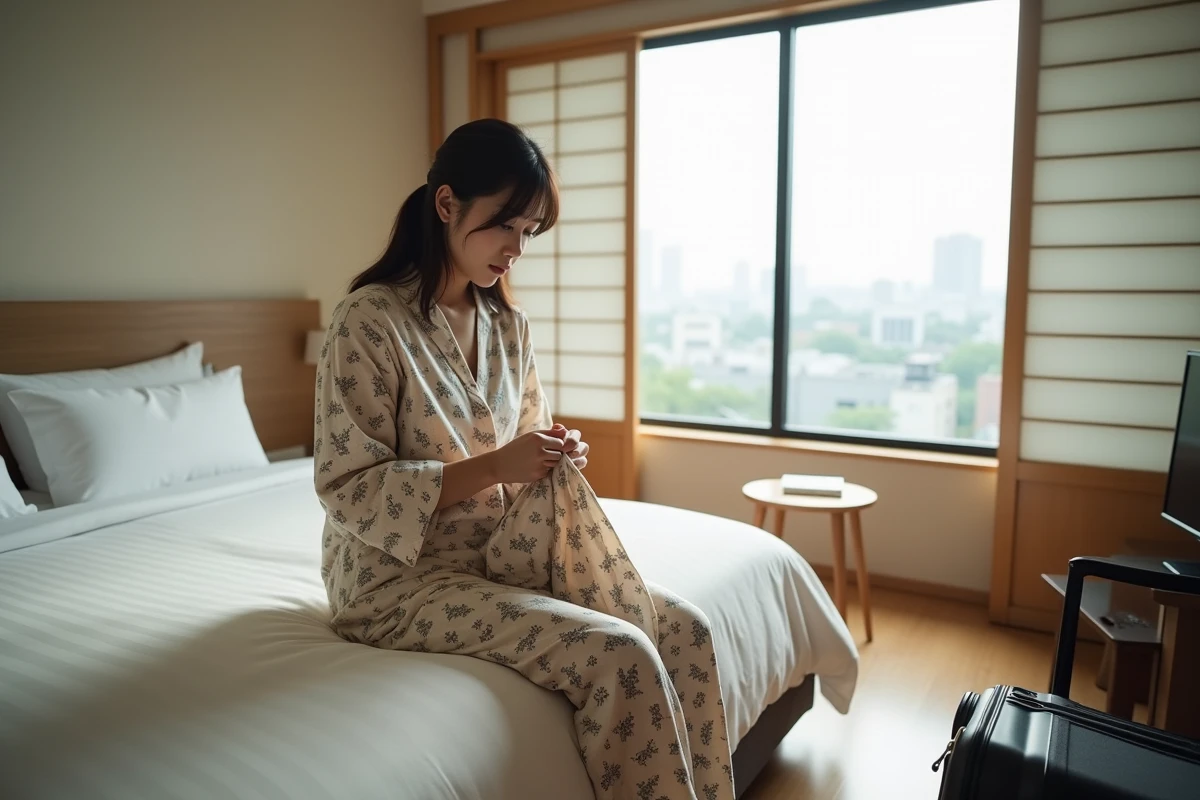
The figure is clear: every year, thousands of travelers leave Japan with a hotel pajama tucked into their suitcase. However, this seemingly innocuous habit is anything but trivial on the other side of the globe. Far from being just a souvenir, the Japanese pajama crystallizes an entire aspect of the culture of hospitality, where every detail matters.
Bringing back the pajama provided in hotels in Japan can sometimes lead to unexpected disappointments: unexpected charges, follow-ups after departure, or polite requests at the reception to return it. There, unless explicitly stated, this garment remains the property of the establishment. It is intended for the stay, washed, and then offered to the next visitor, unlike some slippers that are often given as gifts. Some high-end addresses make exceptions and invite you to take a pajama, well-packaged, with an unequivocal message. For the vast majority of hotels, there is no doubt: if it is not mentioned as a gift, it must remain on-site.
This detail, far from being trivial, illustrates the precision of the rules governing Japanese hospitality. The lending of items provided in the room is not random. These customs, often unknown to international travelers, structure the local experience. Ignoring them can lead to misunderstandings, sometimes altering the perception of the stay, and forces one to realize that Japanese hospitality is based on tacit agreements different from those practiced in Europe.
The hotel pajama in Japan: care and tradition
As soon as the door opens, the eye falls on this pajama or yukata beautifully placed on the bed, near the futon or neatly folded on a bench. An indoor garment or lightweight cotton kimono for the night, it embodies the delicacy of hospitality, both in contemporary hotels and in the heart of a traditional ryokan. Putting it on is allowing oneself a pause in the rhythm of travel, savoring the feeling of being fully welcomed, whether sleeping in Tokyo or in a family inn in Osaka.
Here, nothing is left to chance. The pajama is there to make the stay more pleasant, reconnecting with the spirit of the onsen where the yukata is worn after the bath. Many visitors are surprised to find comfort, simplicity, and a pleasant material. This attention connects each guest to Japanese codes: simplicity, efficiency, respect for others. Wearing this pajama truly contributes to the experience of local hospitality, far beyond a mere accessory.
To explore all the customs and subtleties specific to different establishments, the pajama in Japan on UKR Travel details the practices to know, the differences between modern hotels and ryokan, and provides guidelines to avoid any unpleasant surprises during your next stay.
Loaned pajama or gift: making the distinction to avoid misunderstandings
The question arises with every stay: can one take the pajama offered in Japanese hotels after their stay? The temptation is understandable; these subtly patterned pajamas, soft to the touch, embody a unique memory. But the answer varies depending on the location, the standard, or the type of accommodation.
In the vast majority of cases, the pajama or yukata found in the room is merely a loan, just like the sheets or towels. Hotels explicitly expect it to be returned. Only establishments that clearly indicate that the pajama is a gift stand out, often through a visible mention or individual packaging. Otherwise, it should always be left on-site at the end of the stay.
Some more luxurious hotels or ryokan sometimes display additional attention: a gifted pajama, carefully wrapped, and a note that leaves no doubt. This approach remains minority and primarily targets an international clientele or stays around the onsen.
To clarify, here’s what distinguishes the scenarios:
- Loaned pajama: it must be left in the room upon your departure.
- Gifted pajama: clearly mentioned, often under individual packaging or with an explicit note.
Uncertain? Ask at the reception; no one will mind: the subject is common, and the staff will be able to respond without ambiguity. Leaving with a garment meant to stay can lead to charges or avoidable embarrassment. It would be a shame to tarnish the trust on which Japanese hospitality relies, simply for a pajama.
How to enjoy the hotel pajama without faux pas
Staying in a Japanese hotel means accepting the local rules of the game and aligning with the country’s habits. In Tokyo, in Kansai, or behind the sliding doors of an old inn, wearing the pajama provided is an integral part of the stay. This garment embodies comfort after a bath in an onsen or after exiting a communal shower, accompanying moments when one feels at home even from afar.
Before taking any initiative, take the time to observe the indications left in your room. A yukata pajama to take will almost always be packaged and indicated. If nothing is specified, simply leave it upon your departure. If the question persists, the reception is the preferred point of information: their experience with foreign visitors allows them to clarify the situation without judgment or hesitation.
To avoid any confusing situation, here are some practical tips:
- The pajama or yukata loaned is to be used only within the hotel premises. Going out with it is not usual.
- To have a stay true to the spirit of the place, wearing the yukata pajama with family or friends is also a way to connect with Japanese culture, for a moment.
The difference between traditional Japanese hotels and Western-inspired establishments can be surprising. In a ryokan, keeping the pajama on-site corresponds to a form of respect for a centuries-old tradition of hospitality. Adhering to this custom is to initiate oneself into a different way of traveling, where the memory does not necessarily slip into the suitcase but is experienced on-site, fully.
A simple garment left behind, and there lies the true luxury: leaving with the memory of having been part of a centuries-old, modest, and warm tradition for a few nights.