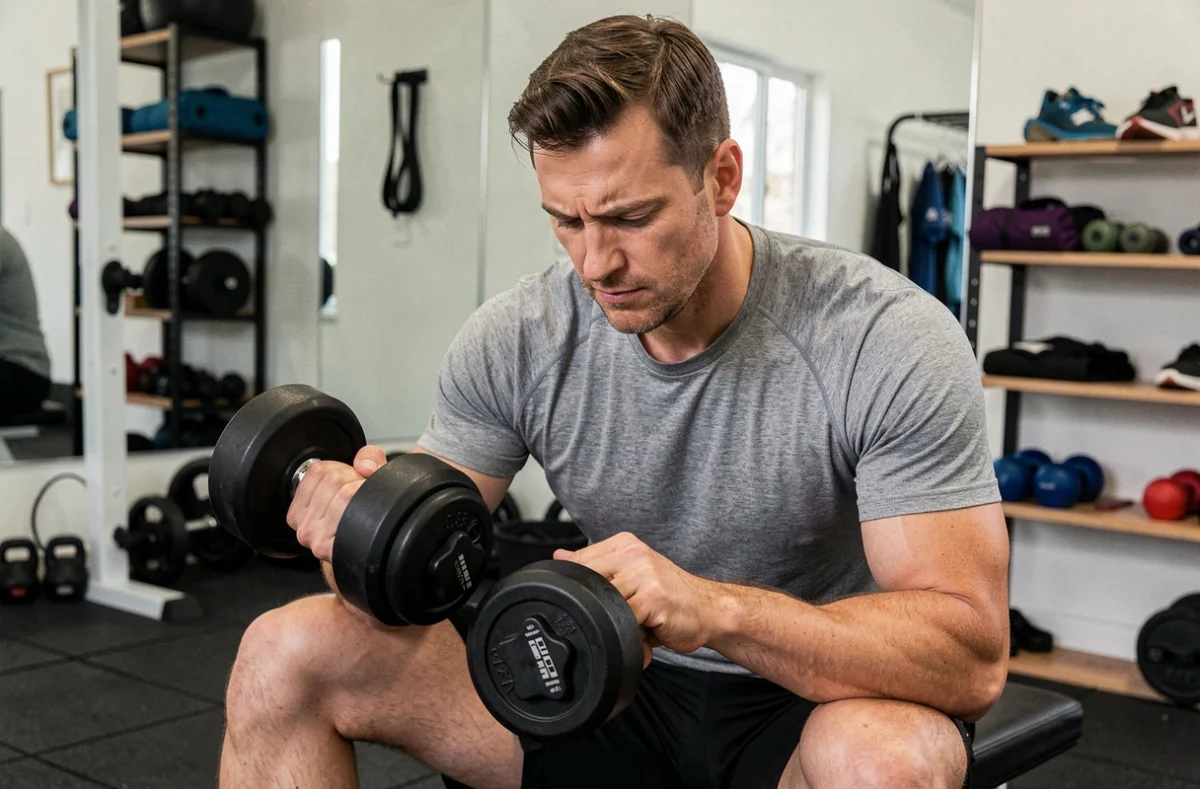
You take the adjustable dumbbell out of its cradle, turn the dial to add two kilos, and the mechanism catches. The plate doesn’t lock into place properly, so you have to put the whole thing back in the stand, realign it, and try again. This happens more often than you might think, and it highlights a reality that space savings alone can’t offset. Before investing in adjustable dumbbells, it’s worth taking an honest look at several drawbacks.
Adjustable dumbbell locking and safety: an often-overlooked issue
The weight-selection mechanism is the heart of an adjustable dumbbell, but it’s also its weakest link. Several product recalls have been documented in the United States in recent years due to locking failures. Plates coming loose mid-rep pose a direct risk of injury.
Before buying, check the model and serial number, especially when shopping secondhand. A dumbbell that has been dropped or has a damaged cradle may have an alignment issue that isn’t immediately visible.
The storage cradle isn’t just there to hold the dumbbell between sets. On several models, proper alignment in the cradle is essential for the selection mechanism to engage correctly. If the stand is unstable or placed on an uneven floor, the system may not lock the plates securely. You could end up handling an unstable weight without realizing it.
For a closer look at the drawbacks of adjustable dumbbells, the long-term reliability of the mechanism remains a key concern, particularly if you train several times a week.
Weight increments and progress: when jumps hold back your training
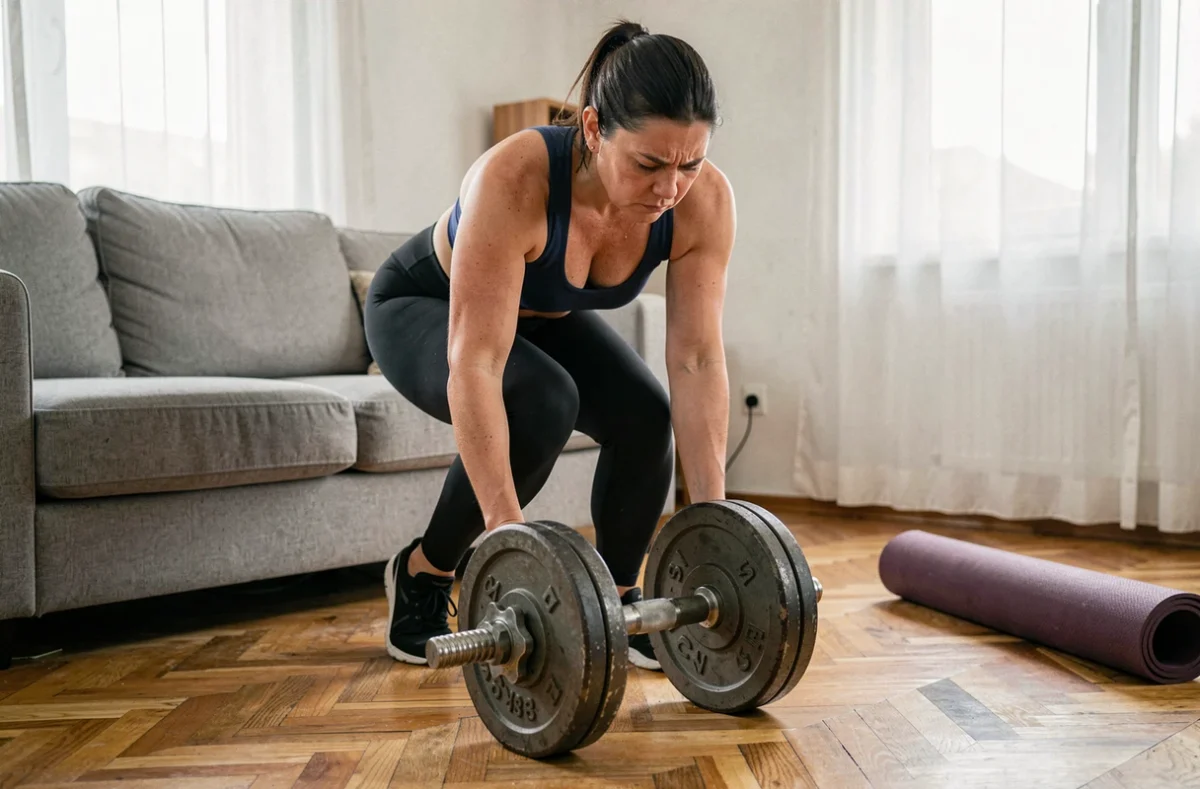
On paper, an adjustable dumbbell covers a wide range (often from a few kilos to more than twenty). In practice, the size of the weight increments makes all the difference. Some models require jumps of around 2.27 kg between settings.
That’s manageable for a bench press or a row. But for lateral raises, curls, or isolation exercises that target smaller muscles, a jump of more than two kilos can stall your progress for weeks. You end up either lifting too little or overloading, with no in-between.
A set of light fixed dumbbells (for example, three pairs ranging from 2 to 8 kg) offers one-kilo increments, sometimes as little as 500 grams. The total cost remains reasonable, and precise loading lets you progress without compromising your form. For fine, controlled movements, that level of precision makes a real difference.
Quick comparison: adjustable dumbbell vs. small set of fixed dumbbells
| Criteria | Adjustable dumbbell | Set of fixed dumbbells (3–4 pairs) |
|---|---|---|
| Available increments | 2–2.5 kg jumps, depending on the model | 0.5–1 kg increments |
| Space required | Low (one cradle) | Moderate (a small rack) |
| Cost | One purchase, higher price | Several purchases, low price per item |
| Impact resistance | Fragile (internal mechanism) | Very durable |
| Suitable for heavy sets where you drop the weights | No | Yes |
For isolation exercises, a combination of adjustable and fixed dumbbells is often the most practical solution.
You can’t drop the weight: a restriction that changes heavy workouts
When you’re lifting heavy at the end of a set, the natural instinct is to put the dumbbells down quickly. With fixed dumbbells, that’s no problem. With an adjustable model, manufacturers explicitly warn against dropping the dumbbell.
An impact can damage the internal plates, throw off the selection rail, or break the locking mechanism. Worse, damage caused by dropping the dumbbell is often excluded from the warranty. You’ll have to pay for repairs or a replacement out of pocket.
This restriction means you have to control the descent at all times, even at the end of a set taken to failure. On a dumbbell bench press, that means always keeping enough energy to set the weights down in a controlled manner. In practice, this limits how hard you can push on certain movements.
Actual space requirements and bar length: the illusion of saving space
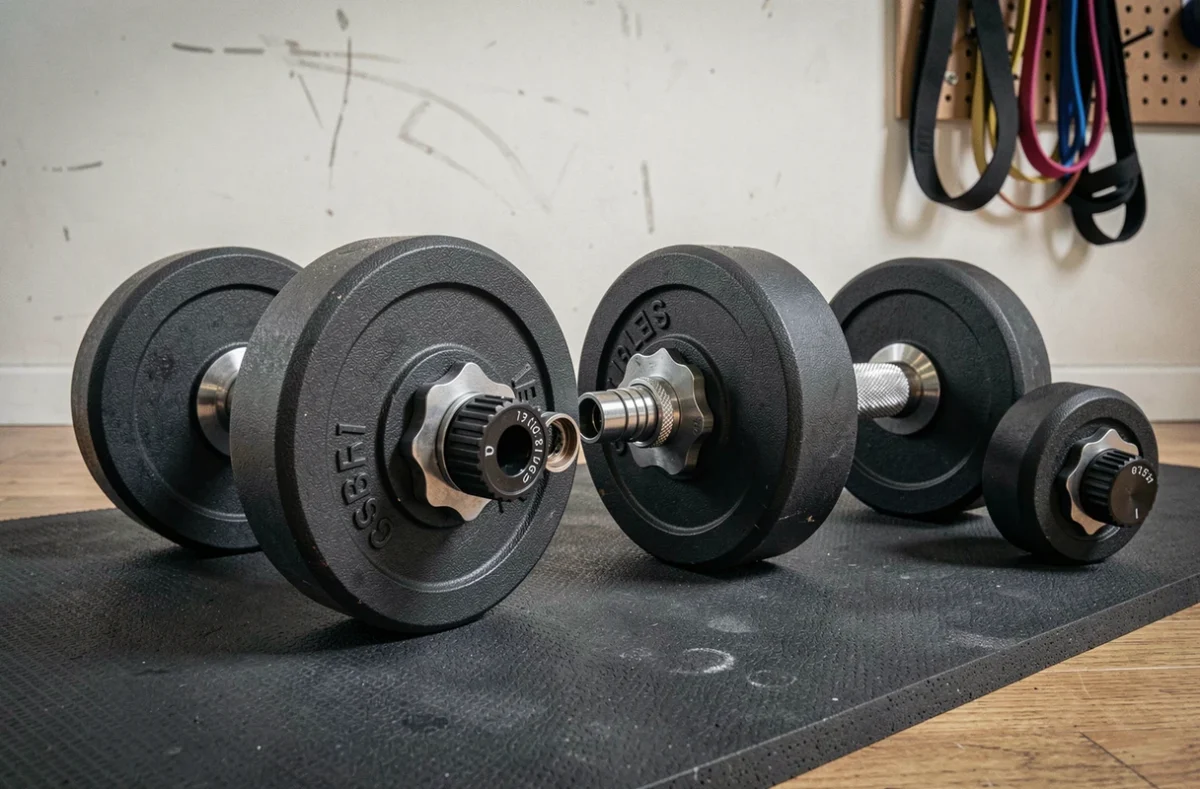
The main selling point of adjustable dumbbells is that they save space. And that’s true: one cradle replaces several pairs. But the length of the dumbbell itself can be a problem that’s rarely mentioned.
An adjustable dumbbell retains its full length even when set to a light weight. On movements where your hands pass close to your body (hammer curls, close-grip presses, front raises), that extra length can get in the way of your range of motion. A light fixed dumbbell is more compact and allows for a more natural movement.
- During concentration curls, the end of an adjustable dumbbell may hit your thigh and limit your range of motion
- During Arnold presses, wrist rotation feels less fluid when the bar extends out on both sides
- During light lateral raises, the extra length creates leverage that changes how heavy the weight feels
So saving space in storage doesn’t necessarily mean greater comfort during exercise. It’s a trade-off to consider based on the movements you do most often.
Adjustable dumbbells: who they’re still a good choice for
These drawbacks don’t rule out adjustable dumbbells. For general home workouts with moderate weights and compound exercises (goblet squats, rows, weighted lunges), a good adjustable model gets the job done. The versatility and space savings are real.
The limitations become apparent when you lift heavy, train individual muscles using small weight increments, or need to drop the weights safely. In those cases, adding two or three carefully chosen pairs of fixed dumbbells can eliminate the frustrations without blowing your budget or taking up too much floor space.
The best choice depends on the exercises you do and the intensity you’re aiming for—not just the number of kilos listed on the box.